
Genobrand™ vs StoryBrand™ Comparison (2026)
Genobrand™ vs StoryBrand™ Comparison (2026)
Genobrand™ vs StoryBrand™ Comparison (2026)
StoryBrand builds marketing clarity. Genobrand builds emotional infrastructure. Discover which framework solves the problem you actually have.
StoryBrand builds marketing clarity. Genobrand builds emotional infrastructure. Discover which framework solves the problem you actually have.
StoryBrand builds marketing clarity. Genobrand builds emotional infrastructure. Discover which framework solves the problem you actually have.
Compare the frameworks
Genobrand™ vs StoryBrand™: The Complete Comparison (2026)
Understanding What Different Frameworks Actually Build
The word "brand" appears in thousands of frameworks, methodologies, and business books. Brand strategy. Brand messaging. Brand identity. Brand storytelling. Brand archetypes.
But here's what most people never stop to consider: just because something has "brand" in the name doesn't mean it's actually building your brand.
Our industry has a language problem. Words like 'brand,' 'branding,' 'marketing,' and 'positioning' get used interchangeably, even though they describe fundamentally different things. The result is that business owners often believe they're building a brand when they're actually improving their marketing. Both are valuable, but they're not the same.
Understanding the difference matters because it shapes your expectations. If you invest in a marketing framework expecting it to transform your organization's identity, you'll be disappointed. Not because the framework failed, but because you were solving a different problem than you thought.
This comparison exists to create clarity.
StoryBrand™ is one of the most popular and effective marketing frameworks of the past decade. Donald Miller created something genuinely valuable. A system that helps businesses communicate clearly and convert more customers. It works exceptionally well for what it's designed to do.
Genobrand™ is something categorically different. It's not a marketing framework at all. It builds emotional infrastructure. The operational system that determines how your entire organization behaves and how people feel about you over time.
One helps you communicate better. The other transforms what you are.
This isn't about which is 'better.' That question doesn't make sense when comparing tools designed for different purposes. A hammer isn't better than a screwdriver. They solve different problems.
What matters is understanding what each framework actually builds, so you can choose the right tool for what you're actually trying to accomplish.
Prefer to watch? An AI-generated video breakdown of this article is below. Useful for commutes, workouts, or when reading isn't an option.
What Is StoryBrand™?
StoryBrand is a marketing framework developed by Donald Miller, first introduced in his 2017 bestseller Building a StoryBrand. The framework applies classic storytelling structure, specifically Joseph Campbell's Hero's Journey, to business communication.
The core insight is powerful: customers are the heroes of their own stories, and businesses should position themselves as guides who help heroes win.
This reverses the traditional marketing approach where companies talk about themselves ("We're the best! We've been in business for 30 years!"). Instead, StoryBrand positions the customer's problem as the central conflict and the business as the trusted guide with a plan.
The framework consists of seven elements (the SB7 Framework):
A Character (your customer) has a problem
And meets a Guide (your business) who has empathy and authority
Who gives them a Plan that's simple and clear
And calls them to Action
That helps them avoid Failure
And ends in Success
Practitioners use this framework to write website copy, create marketing campaigns, develop sales scripts, and build lead-generating funnels.
StoryBrand has certified thousands of guides worldwide and helped countless businesses clarify their messaging. It's become one of the most popular marketing frameworks of the past decade for good reason.
What StoryBrand Does Exceptionally Well
Let's be direct: StoryBrand works. Here's where it genuinely excels.
1. Eliminates Confusing Messaging
Most businesses talk about themselves in ways customers don't care about. StoryBrand ruthlessly cuts the self-congratulation and forces clarity. If you can't explain what you do in terms of your customer's problem and desired outcome, StoryBrand will fix that.
The 'grunt test' alone has saved countless businesses from marketing that says everything and communicates nothing. Can a caveman look at your website and understand what you offer, how it makes their life better, and what they need to do to get it? If not, StoryBrand will tell you what's wrong.
2. Provides a Repeatable Framework
The SB7 structure gives teams a shared language. Instead of debating whether copy "feels right," you can evaluate it against clear criteria. Does it position the customer as hero? Does it show empathy before authority? Is there a clear call to action?
This repeatability is genuinely valuable. It takes the guesswork out of marketing and gives even non-writers a template they can follow.
3. Creates Immediate Conversion Improvements
Businesses that implement StoryBrand properly typically see measurable improvements in website conversions, email engagement, and sales conversations. When your messaging finally speaks to what customers actually care about, they respond.
The bottom line: If your problem is "our marketing doesn't work because nobody understands what we do," StoryBrand is an excellent solution.
Where StoryBrand Stops Short
Now let's ask some honest questions about what StoryBrand was never designed to address.
How does StoryBrand help you hire the right people?
When you're interviewing candidates, what does StoryBrand tell you to look for? How does "the customer is the hero" help you evaluate cultural fit? What questions should you ask to ensure a new employee will reinforce what your company stands for?
StoryBrand doesn't address this because it's a marketing framework, not an operational one. There's nothing wrong with that. Unless you thought it would solve problems it was never meant to solve.
What happens after the transaction?
StoryBrand is optimized for the moment before purchase. It's designed to get customers to say yes. But what about day 30? Day 365? Year five?
How does StoryBrand guide your customer service approach? How does it inform product development decisions? How does it shape the experience that turns customers into evangelists?
The framework largely ends where the relationship should begin.
How does the customer-as-hero positioning create movements?
When you tell customers they're the heroes, you're speaking to them as individuals. 'You're the hero of your story.' This is effective for conversion. It doesn't create belonging.
Think about the brands people tattoo on their bodies. The companies whose logos people wear with pride. The products people defend in arguments with strangers.
Are those people thinking, "I'm the hero and this brand is my guide"? Or are they thinking, "I belong to something. We believe this together"?
Individual heroism is powerful for transactions. Collective identity is what creates movements.
Where is the behavioural infrastructure?
StoryBrand produces marketing collateral: website copy, email sequences, sales scripts, lead magnets.
But ask yourself: If every employee in your company internalized StoryBrand perfectly, would they know how to behave in situations that aren't covered by a script? Would they make consistent decisions when facing novel challenges? Would customers experience emotional consistency across every touchpoint?
StoryBrand clarifies what to say. It doesn't build the infrastructure that determines what you do.
How Genobrand™ Is Categorically Different
Here's where we need to be precise about language.
Genobrand™ isn't a "better" marketing framework. It's not an "evolution" of StoryBrand. It's not a replacement you swap in when you want upgraded results.
Genobrand™ is categorically different because it solves a categorically different problem.
StoryBrand asks: "How do we communicate clearly so customers choose us?"
Genobrand™ asks: 'How do we build the emotional infrastructure that makes people believe in us, and behave accordingly?"
The first is a marketing question. The second is an identity question.
Beyond Product and Service
Most frameworks, including StoryBrand, are ultimately designed to sell more effectively. They improve how you communicate what you offer. They make the path to purchase clearer. They're valuable precisely because they work.
But they're still anchored to the transaction.
Genobrand™ operates at a different level. It's not about selling a product or service more effectively. It's about intentionally generating an emotional connection that exists independently of any single transaction.
Think about the difference:
Transactional approach: "How do we make people want to buy this?"
Genobrand™ approach: "How do we make people feel something they want to feel again, and associate that feeling with us?"
This isn't hoping that good marketing creates positive emotions as a byproduct. It's engineering emotional infrastructure deliberately, so the feeling comes first and the transaction becomes a natural expression of that feeling.
When someone buys Nike, they're not just purchasing shoes. They're accessing a feeling. The empowerment of 'Just Do It.' The product is the vehicle, not the destination.
When someone chooses Apple, they're not just buying technology. They're reinforcing their identity as someone who thinks differently. The device is proof of belonging.
This is why these brands can charge premium prices, inspire fierce loyalty, and survive product failures that would destroy competitors. The emotional connection exists beyond any single product or service.
The Message Is The Hero™
This philosophical distinction makes the "beyond product" approach possible.
StoryBrand positions the customer as hero and the business as guide. This works for selling. It puts customer needs first and positions your offer as the solution.
Genobrand™ positions THE MESSAGE as what everyone rallies around together. Company and customer alike.
Consider Nike's "Just Do It."
Is Nike telling you that you're the hero and Nike is your guide? That's not how it feels. 'Just Do It' isn't about you alone. It's a collective declaration that everyone who believes it joins together. The MESSAGE is the hero. The refusal to make excuses. The choice to act despite fear.
Everyone who believes the message becomes part of something larger than themselves. Larger than any single product.
This isn't just philosophical distinction. It has practical implications:
StoryBrand creates customers who bought from you
Genobrand™ creates believers who belong with you
StoryBrand produces transactions
Genobrand™ produces movements
StoryBrand makes your marketing consistent
Genobrand™ makes your entire organization consistent
The Emotional Operating System™
This is what Genobrand™ actually produces. It's categorically different from what any marketing framework delivers.
A Genobrand is the emotional infrastructure that determines how an organization behaves and how people feel about it over time. But infrastructure alone is just a concept. It needs a system to make it operational.
The Emotional Operating System is that system. It's the internal architecture that turns a Genobrand from idea into reality. It guides decisions, ensures consistency, and creates the connection that marketing frameworks cannot manufacture.
At the core of the Emotional Operating System is the Attention Formula™:
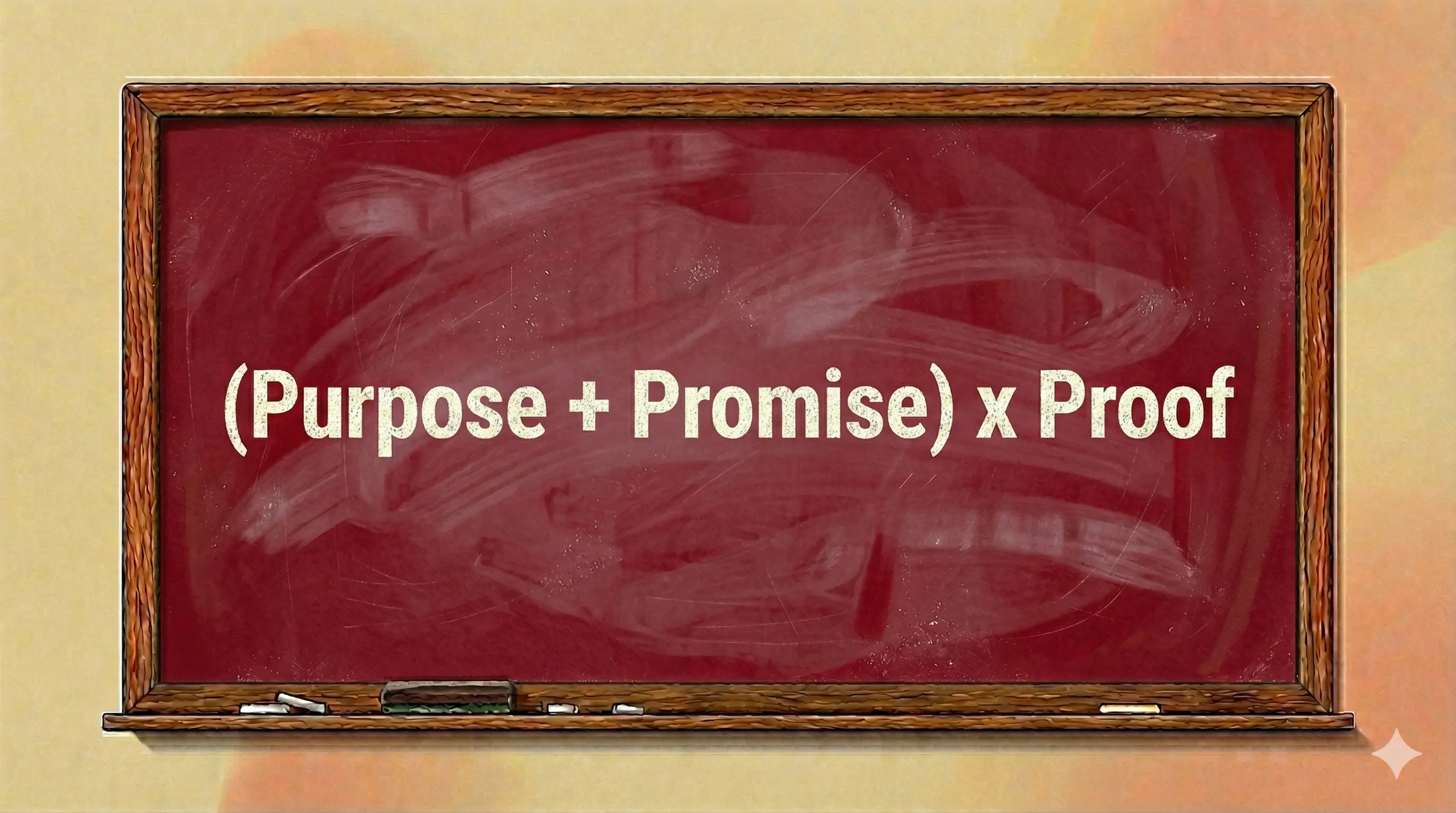
(Purpose + Promise) × Proof = Lasting Emotional Connection
Purpose (Core Purpose Statement™)
The belief that everyone rallies around. Not your company's internal "why," but the shared conviction that unites your organization and your audience. Expressed in 2-7 words.
Promise (Transformational Promise Statement™)
The specific transformation you deliver. Not what you do, but what becomes possible because of what you do.
Proof (Emotional Touchpoints™ & Receipts™)
The systematic behavioural evidence that validates your Purpose and Promise through consistent action.
The critical insight is the multiplication sign. Without Proof, everything equals zero. You can have the most compelling Purpose and the most attractive Promise. If your behaviour doesn't prove it, you've built nothing.
This is why most "brand work" fails. Companies develop beautiful mission statements and promising taglines, then behave in ways that contradict them. The math doesn't work. Any number multiplied by zero equals zero.
The Emotional Operating System also includes the Genobrand Story™. It's the complete narrative framework that communicates your Purpose, Promise, and Proof in a way that invites people to belong.
This isn't a document that goes in a drawer. It's operational infrastructure that runs your business.
How do you hire? Look for candidates who genuinely believe your Core Purpose. Skill is teachable. Belief is not.
How do you handle customer complaints? Treat the response as an Emotional Touchpoint. The complaint itself is forgettable. How you respond becomes part of what you're known for.
How do you design products and experiences? Build them as expressions of your Purpose, not features in a market. Apple's design language wasn't differentiation strategy. It was 'Think Different' made tangible.
How do you make decisions when facing uncertainty? Use the emotional infrastructure as the guide. Most businesses default to gut feeling or hope. The Emotional Operating System replaces both with reasoning you can actually defend.
The Emotional Operating System isn't marketing you apply after the fact. It's the foundation everything else emerges from.
When to Use Each Framework
Let's be practical about when each approach makes sense.
Use StoryBrand When:
Your messaging is confusing and customers don't understand what you do or why it matters to them
You need quick marketing wins like improved website conversions or better email engagement
You're a solopreneur or small team focused primarily on sales and marketing
Your business model is transactional with short customer relationships
You have limited budget and need the highest-impact marketing improvement per dollar
Your brand foundation already exists and you just need clearer communication
StoryBrand is an excellent tactical solution for a specific problem: unclear marketing messaging.
Use Genobrand™ When:
Clear marketing hasn't created lasting loyalty and customers still don't feel connected to your company
You need organizational alignment and want every team member operating from shared conviction
You're building for long-term equity and want compounding brand value, not just campaigns
Customer relationships extend beyond purchase with ongoing service, subscription, or lifetime value
You're preparing for scale and need infrastructure that maintains consistency as you grow
You want to build a movement where customers become believers, not just buyers
Genobrand™ is the right choice when you need to build what you are, not just communicate what you do.
The Honest Answer
It depends on what you're prioritizing, and what problem is actually causing the friction.
If your primary challenge is messaging clarity, where customers don't understand what you offer or why it matters, a marketing framework like StoryBrand can absolutely help with that.
But if you find yourself unable to confidently answer foundational questions like 'What do we stand for?' or 'What do we believe that our customers believe too?', the emotional infrastructure is missing. Clearer marketing messaging won't solve that.
Sometimes what looks like a messaging problem is actually a foundation problem. Marketing becomes easier to clarify when you know what you're building on top of.
The question isn't which framework comes first. The question is: What's actually missing?
If it's communication clarity, address that.
If it's the foundation itself, the emotional infrastructure that everything else should emerge from, that's what Genobrand™ and the Emotional Operating System™ are designed to build.
Why the Emotional Operating System™ Matters
Here's the question that separates marketing from infrastructure:
What happens when there's no script?
StoryBrand gives you messaging frameworks for predictable situations: websites, emails, sales calls, lead magnets. These cover a lot of ground.
But business is full of unpredictable situations:
A customer complaint that doesn't fit any category
A product decision where the data could support multiple options
A hiring choice between two qualified candidates
A partnership opportunity that requires values alignment
A crisis that demands immediate response
In these moments, messaging frameworks can't help. You need something deeper. A shared understanding of what you believe and how someone who believes that would behave.
The Emotional Operating System provides this. When employees know the Core Purpose, they can make decisions without scripts. When leadership understands the Transformational Promise, they can evaluate opportunities through consistent criteria. When everyone recognizes what constitutes Proof, they can create Emotional Receipts in novel situations.
This is the difference between a company with good marketing and a brand that earns trust.
People don't trust what they like. They trust what they can predict emotionally.
This is the Law of Emotional Consistency.
Consistency isn't about being boring. It's about being reliable at the emotional level. Customers learn they can expect a certain feeling from every interaction. That predictability becomes trust.
StoryBrand can make your marketing consistent. Only an Emotional Operating System can make your entire organization emotionally consistent.
Comparison: StoryBrand™ vs Genobrand™
Dimension | StoryBrand™ | Genobrand™ |
Core Philosophy | Customer is the hero | The Message is the hero, and everyone rallies around it together |
Primary Output | Marketing messaging and website copy | Emotional Operating System™ (complete infrastructure) |
Focus | Pre-transaction communication | Entire organizational behaviour and customer relationship |
Scope | Marketing and sales | Hiring, operations, product, culture, customer experience |
Framework | SB7 storytelling structure | Attention Formula™: (Purpose + Promise) × Proof |
Creates | Clear messaging that converts | Behavioural infrastructure that compounds |
Proof Mechanism | Testimonials and success stories | Systematic Emotional Touchpoints™ & Receipts™ |
Team Alignment | Shared marketing language | Shared belief system and behavioural standards |
Customer Relationship | Guides heroes to purchase | Unites believers in shared identity |
Long-term Effect | Better marketing campaigns | Compounding brand equity and loyalty |
Primary Question | "How do we communicate clearly?" | "How do we build emotional infrastructure?" |
Ends When | Customer purchases | Never. It's ongoing operational infrastructure |
Conclusion: Expose Your Greatness
StoryBrand is a genuinely valuable framework that solves a real problem. If your marketing messaging is confusing, unclear, or self-centred, StoryBrand will fix that. Donald Miller created something that has helped thousands of businesses communicate more effectively.
But StoryBrand is a marketing framework. It builds marketing assets. Websites, funnels, sales scripts, email sequences.
Genobrand is an identity framework. It builds operational infrastructure. The Emotional Operating System that determines how your entire organization behaves.
They're not competitors. They're not interchangeable. They're not different versions of the same thing.
They're categorically different because they solve categorically different problems.
If you need clearer marketing, StoryBrand delivers.
If you need to build what you are, not just communicate what you do, you need something that operates at a fundamentally different level.
Marketing frameworks help you say the right things. The Emotional Operating System ensures you are the right things. And that every touchpoint proves it.
Expose your greatness. Not through clearer messaging alone, but through the emotional infrastructure that makes your message undeniable.
Frequently Asked Questions
Can I use StoryBrand and Genobrand™ together?
Yes, but understand they solve different problems. StoryBrand addresses marketing messaging. Genobrand builds operational infrastructure. If your messaging is unclear, StoryBrand can help clarify it. That clarity will be limited to marketing unless you also build the Emotional Operating System that runs everything else.
I already invested in StoryBrand certification/implementation. Is that wasted?
Not at all. Clear messaging is valuable. The work you did with StoryBrand likely improved your marketing, and that improvement remains useful.
Genobrand doesn't replace that work; it builds foundation underneath it. Your StoryBrand messaging becomes more powerful when it emerges from genuine Core Purpose rather than tactical positioning.
What's the difference between "brand" and "branding"?
This distinction is crucial. 'Branding' is what you do to get noticed. Visual identity, marketing campaigns, messaging strategies. 'Brand' is what you are. The emotional infrastructure that determines how you behave and how people feel about you.
StoryBrand is a branding/marketing framework (it improves how you communicate). Genobrand builds brand (it transforms what you are).
Is Genobrand™ only for large companies?
No. The principles apply at any scale. However, the impact often becomes most visible when organizations need to maintain consistency across multiple people, departments, or locations. Solopreneurs focused purely on marketing may find StoryBrand sufficient for their needs.
How do I know if I need Genobrand™ vs just better marketing?
Ask yourself these questions: Do you and/or your employees struggle to articulate what your company stands for? Do customers buy once but rarely become evangelists? Does your marketing feel disconnected from your operations? Would customers experience inconsistency across different touchpoints? Are you preparing for growth that requires maintaining culture at scale?
If you answered yes to any of these, you likely need infrastructure, not just messaging. That's where Genobrand and the Emotional Operating System become relevant.
How can understanding this distinction help me sell better?
StoryBrand helps you explain your offer clearly. Genobrand helps prospects believe you before you explain anything. When you have a Core Purpose and Transformational Promise, sales conversations start from trust rather than from zero. You're not just the guide in their story. You're someone who stands for something they already believe in. Clear messaging gets attention. Emotional infrastructure gets commitment.
How does this change how I approach marketing?
StoryBrand gives you a framework for what to say. Genobrand gives you a foundation for why it matters. With StoryBrand alone, your marketing is clear but may feel interchangeable with competitors using the same framework. With Genobrand underneath, your marketing expresses something only you can say. It comes from your specific Purpose, Promise, and Proof. The message becomes yours, not a template.
How can this help me create better content?
StoryBrand provides a formula for structuring content around customer problems and solutions. That's useful for clarity. Content built only on formula can feel mechanical. When you have a Core Purpose Statement, your content has a centre to draw from. Each piece isn't just solving a problem. It's proving what you stand for. Content shifts from following a framework to expressing an identity. The formula still works, but now there's conviction underneath it.
How does this affect how I spend money on advertising?
StoryBrand helps you write clearer ads. Genobrand helps those ads compound into something people remember. Without emotional infrastructure, even clear ads reset every campaign. You're always reintroducing yourself. With Purpose, Promise, and Proof, each ad reinforces the same identity. Your spend builds equity instead of just buying attention. Same budget, but now each dollar deposits into something that lasts.
Disclosure
Genobrand™, the Emotional Operating System™, the Attention Formula™, Message Is The Hero™, Core Purpose Statement™, Transformational Promise Statement™, Emotional Touchpoints™, Emotional Receipts™, and Genobrand Story™ are proprietary frameworks developed and created by Disco Davoudi.
This comparison was written to help you make an informed decision. Not to convince you that one framework is universally 'better.' Both solve real problems. The question is which problem you actually need solved.
What's Next
If this resonated, download and read Brand Crimes. My free guide on why most brand strategy fails and what to do instead.
Genobrand™ vs StoryBrand™: The Complete Comparison (2026)
Understanding What Different Frameworks Actually Build
The word "brand" appears in thousands of frameworks, methodologies, and business books. Brand strategy. Brand messaging. Brand identity. Brand storytelling. Brand archetypes.
But here's what most people never stop to consider: just because something has "brand" in the name doesn't mean it's actually building your brand.
Our industry has a language problem. Words like 'brand,' 'branding,' 'marketing,' and 'positioning' get used interchangeably, even though they describe fundamentally different things. The result is that business owners often believe they're building a brand when they're actually improving their marketing. Both are valuable, but they're not the same.
Understanding the difference matters because it shapes your expectations. If you invest in a marketing framework expecting it to transform your organization's identity, you'll be disappointed. Not because the framework failed, but because you were solving a different problem than you thought.
This comparison exists to create clarity.
StoryBrand™ is one of the most popular and effective marketing frameworks of the past decade. Donald Miller created something genuinely valuable. A system that helps businesses communicate clearly and convert more customers. It works exceptionally well for what it's designed to do.
Genobrand™ is something categorically different. It's not a marketing framework at all. It builds emotional infrastructure. The operational system that determines how your entire organization behaves and how people feel about you over time.
One helps you communicate better. The other transforms what you are.
This isn't about which is 'better.' That question doesn't make sense when comparing tools designed for different purposes. A hammer isn't better than a screwdriver. They solve different problems.
What matters is understanding what each framework actually builds, so you can choose the right tool for what you're actually trying to accomplish.
Prefer to watch? An AI-generated video breakdown of this article is below. Useful for commutes, workouts, or when reading isn't an option.
What Is StoryBrand™?
StoryBrand is a marketing framework developed by Donald Miller, first introduced in his 2017 bestseller Building a StoryBrand. The framework applies classic storytelling structure, specifically Joseph Campbell's Hero's Journey, to business communication.
The core insight is powerful: customers are the heroes of their own stories, and businesses should position themselves as guides who help heroes win.
This reverses the traditional marketing approach where companies talk about themselves ("We're the best! We've been in business for 30 years!"). Instead, StoryBrand positions the customer's problem as the central conflict and the business as the trusted guide with a plan.
The framework consists of seven elements (the SB7 Framework):
A Character (your customer) has a problem
And meets a Guide (your business) who has empathy and authority
Who gives them a Plan that's simple and clear
And calls them to Action
That helps them avoid Failure
And ends in Success
Practitioners use this framework to write website copy, create marketing campaigns, develop sales scripts, and build lead-generating funnels.
StoryBrand has certified thousands of guides worldwide and helped countless businesses clarify their messaging. It's become one of the most popular marketing frameworks of the past decade for good reason.
What StoryBrand Does Exceptionally Well
Let's be direct: StoryBrand works. Here's where it genuinely excels.
1. Eliminates Confusing Messaging
Most businesses talk about themselves in ways customers don't care about. StoryBrand ruthlessly cuts the self-congratulation and forces clarity. If you can't explain what you do in terms of your customer's problem and desired outcome, StoryBrand will fix that.
The 'grunt test' alone has saved countless businesses from marketing that says everything and communicates nothing. Can a caveman look at your website and understand what you offer, how it makes their life better, and what they need to do to get it? If not, StoryBrand will tell you what's wrong.
2. Provides a Repeatable Framework
The SB7 structure gives teams a shared language. Instead of debating whether copy "feels right," you can evaluate it against clear criteria. Does it position the customer as hero? Does it show empathy before authority? Is there a clear call to action?
This repeatability is genuinely valuable. It takes the guesswork out of marketing and gives even non-writers a template they can follow.
3. Creates Immediate Conversion Improvements
Businesses that implement StoryBrand properly typically see measurable improvements in website conversions, email engagement, and sales conversations. When your messaging finally speaks to what customers actually care about, they respond.
The bottom line: If your problem is "our marketing doesn't work because nobody understands what we do," StoryBrand is an excellent solution.
Where StoryBrand Stops Short
Now let's ask some honest questions about what StoryBrand was never designed to address.
How does StoryBrand help you hire the right people?
When you're interviewing candidates, what does StoryBrand tell you to look for? How does "the customer is the hero" help you evaluate cultural fit? What questions should you ask to ensure a new employee will reinforce what your company stands for?
StoryBrand doesn't address this because it's a marketing framework, not an operational one. There's nothing wrong with that. Unless you thought it would solve problems it was never meant to solve.
What happens after the transaction?
StoryBrand is optimized for the moment before purchase. It's designed to get customers to say yes. But what about day 30? Day 365? Year five?
How does StoryBrand guide your customer service approach? How does it inform product development decisions? How does it shape the experience that turns customers into evangelists?
The framework largely ends where the relationship should begin.
How does the customer-as-hero positioning create movements?
When you tell customers they're the heroes, you're speaking to them as individuals. 'You're the hero of your story.' This is effective for conversion. It doesn't create belonging.
Think about the brands people tattoo on their bodies. The companies whose logos people wear with pride. The products people defend in arguments with strangers.
Are those people thinking, "I'm the hero and this brand is my guide"? Or are they thinking, "I belong to something. We believe this together"?
Individual heroism is powerful for transactions. Collective identity is what creates movements.
Where is the behavioural infrastructure?
StoryBrand produces marketing collateral: website copy, email sequences, sales scripts, lead magnets.
But ask yourself: If every employee in your company internalized StoryBrand perfectly, would they know how to behave in situations that aren't covered by a script? Would they make consistent decisions when facing novel challenges? Would customers experience emotional consistency across every touchpoint?
StoryBrand clarifies what to say. It doesn't build the infrastructure that determines what you do.
How Genobrand™ Is Categorically Different
Here's where we need to be precise about language.
Genobrand™ isn't a "better" marketing framework. It's not an "evolution" of StoryBrand. It's not a replacement you swap in when you want upgraded results.
Genobrand™ is categorically different because it solves a categorically different problem.
StoryBrand asks: "How do we communicate clearly so customers choose us?"
Genobrand™ asks: 'How do we build the emotional infrastructure that makes people believe in us, and behave accordingly?"
The first is a marketing question. The second is an identity question.
Beyond Product and Service
Most frameworks, including StoryBrand, are ultimately designed to sell more effectively. They improve how you communicate what you offer. They make the path to purchase clearer. They're valuable precisely because they work.
But they're still anchored to the transaction.
Genobrand™ operates at a different level. It's not about selling a product or service more effectively. It's about intentionally generating an emotional connection that exists independently of any single transaction.
Think about the difference:
Transactional approach: "How do we make people want to buy this?"
Genobrand™ approach: "How do we make people feel something they want to feel again, and associate that feeling with us?"
This isn't hoping that good marketing creates positive emotions as a byproduct. It's engineering emotional infrastructure deliberately, so the feeling comes first and the transaction becomes a natural expression of that feeling.
When someone buys Nike, they're not just purchasing shoes. They're accessing a feeling. The empowerment of 'Just Do It.' The product is the vehicle, not the destination.
When someone chooses Apple, they're not just buying technology. They're reinforcing their identity as someone who thinks differently. The device is proof of belonging.
This is why these brands can charge premium prices, inspire fierce loyalty, and survive product failures that would destroy competitors. The emotional connection exists beyond any single product or service.
The Message Is The Hero™
This philosophical distinction makes the "beyond product" approach possible.
StoryBrand positions the customer as hero and the business as guide. This works for selling. It puts customer needs first and positions your offer as the solution.
Genobrand™ positions THE MESSAGE as what everyone rallies around together. Company and customer alike.
Consider Nike's "Just Do It."
Is Nike telling you that you're the hero and Nike is your guide? That's not how it feels. 'Just Do It' isn't about you alone. It's a collective declaration that everyone who believes it joins together. The MESSAGE is the hero. The refusal to make excuses. The choice to act despite fear.
Everyone who believes the message becomes part of something larger than themselves. Larger than any single product.
This isn't just philosophical distinction. It has practical implications:
StoryBrand creates customers who bought from you
Genobrand™ creates believers who belong with you
StoryBrand produces transactions
Genobrand™ produces movements
StoryBrand makes your marketing consistent
Genobrand™ makes your entire organization consistent
The Emotional Operating System™
This is what Genobrand™ actually produces. It's categorically different from what any marketing framework delivers.
A Genobrand is the emotional infrastructure that determines how an organization behaves and how people feel about it over time. But infrastructure alone is just a concept. It needs a system to make it operational.
The Emotional Operating System is that system. It's the internal architecture that turns a Genobrand from idea into reality. It guides decisions, ensures consistency, and creates the connection that marketing frameworks cannot manufacture.
At the core of the Emotional Operating System is the Attention Formula™:
(Purpose + Promise) × Proof = Lasting Emotional Connection
Purpose (Core Purpose Statement™)
The belief that everyone rallies around. Not your company's internal "why," but the shared conviction that unites your organization and your audience. Expressed in 2-7 words.
Promise (Transformational Promise Statement™)
The specific transformation you deliver. Not what you do, but what becomes possible because of what you do.
Proof (Emotional Touchpoints™ & Receipts™)
The systematic behavioural evidence that validates your Purpose and Promise through consistent action.
The critical insight is the multiplication sign. Without Proof, everything equals zero. You can have the most compelling Purpose and the most attractive Promise. If your behaviour doesn't prove it, you've built nothing.
This is why most "brand work" fails. Companies develop beautiful mission statements and promising taglines, then behave in ways that contradict them. The math doesn't work. Any number multiplied by zero equals zero.
The Emotional Operating System also includes the Genobrand Story™. It's the complete narrative framework that communicates your Purpose, Promise, and Proof in a way that invites people to belong.
This isn't a document that goes in a drawer. It's operational infrastructure that runs your business.
How do you hire? Look for candidates who genuinely believe your Core Purpose. Skill is teachable. Belief is not.
How do you handle customer complaints? Treat the response as an Emotional Touchpoint. The complaint itself is forgettable. How you respond becomes part of what you're known for.
How do you design products and experiences? Build them as expressions of your Purpose, not features in a market. Apple's design language wasn't differentiation strategy. It was 'Think Different' made tangible.
How do you make decisions when facing uncertainty? Use the emotional infrastructure as the guide. Most businesses default to gut feeling or hope. The Emotional Operating System replaces both with reasoning you can actually defend.
The Emotional Operating System isn't marketing you apply after the fact. It's the foundation everything else emerges from.
When to Use Each Framework
Let's be practical about when each approach makes sense.
Use StoryBrand When:
Your messaging is confusing and customers don't understand what you do or why it matters to them
You need quick marketing wins like improved website conversions or better email engagement
You're a solopreneur or small team focused primarily on sales and marketing
Your business model is transactional with short customer relationships
You have limited budget and need the highest-impact marketing improvement per dollar
Your brand foundation already exists and you just need clearer communication
StoryBrand is an excellent tactical solution for a specific problem: unclear marketing messaging.
Use Genobrand™ When:
Clear marketing hasn't created lasting loyalty and customers still don't feel connected to your company
You need organizational alignment and want every team member operating from shared conviction
You're building for long-term equity and want compounding brand value, not just campaigns
Customer relationships extend beyond purchase with ongoing service, subscription, or lifetime value
You're preparing for scale and need infrastructure that maintains consistency as you grow
You want to build a movement where customers become believers, not just buyers
Genobrand™ is the right choice when you need to build what you are, not just communicate what you do.
The Honest Answer
It depends on what you're prioritizing, and what problem is actually causing the friction.
If your primary challenge is messaging clarity, where customers don't understand what you offer or why it matters, a marketing framework like StoryBrand can absolutely help with that.
But if you find yourself unable to confidently answer foundational questions like 'What do we stand for?' or 'What do we believe that our customers believe too?', the emotional infrastructure is missing. Clearer marketing messaging won't solve that.
Sometimes what looks like a messaging problem is actually a foundation problem. Marketing becomes easier to clarify when you know what you're building on top of.
The question isn't which framework comes first. The question is: What's actually missing?
If it's communication clarity, address that.
If it's the foundation itself, the emotional infrastructure that everything else should emerge from, that's what Genobrand™ and the Emotional Operating System™ are designed to build.
Why the Emotional Operating System™ Matters
Here's the question that separates marketing from infrastructure:
What happens when there's no script?
StoryBrand gives you messaging frameworks for predictable situations: websites, emails, sales calls, lead magnets. These cover a lot of ground.
But business is full of unpredictable situations:
A customer complaint that doesn't fit any category
A product decision where the data could support multiple options
A hiring choice between two qualified candidates
A partnership opportunity that requires values alignment
A crisis that demands immediate response
In these moments, messaging frameworks can't help. You need something deeper. A shared understanding of what you believe and how someone who believes that would behave.
The Emotional Operating System provides this. When employees know the Core Purpose, they can make decisions without scripts. When leadership understands the Transformational Promise, they can evaluate opportunities through consistent criteria. When everyone recognizes what constitutes Proof, they can create Emotional Receipts in novel situations.
This is the difference between a company with good marketing and a brand that earns trust.
People don't trust what they like. They trust what they can predict emotionally.
This is the Law of Emotional Consistency.
Consistency isn't about being boring. It's about being reliable at the emotional level. Customers learn they can expect a certain feeling from every interaction. That predictability becomes trust.
StoryBrand can make your marketing consistent. Only an Emotional Operating System can make your entire organization emotionally consistent.
Comparison: StoryBrand™ vs Genobrand™
Dimension | StoryBrand™ | Genobrand™ |
Core Philosophy | Customer is the hero | The Message is the hero, and everyone rallies around it together |
Primary Output | Marketing messaging and website copy | Emotional Operating System™ (complete infrastructure) |
Focus | Pre-transaction communication | Entire organizational behaviour and customer relationship |
Scope | Marketing and sales | Hiring, operations, product, culture, customer experience |
Framework | SB7 storytelling structure | Attention Formula™: (Purpose + Promise) × Proof |
Creates | Clear messaging that converts | Behavioural infrastructure that compounds |
Proof Mechanism | Testimonials and success stories | Systematic Emotional Touchpoints™ & Receipts™ |
Team Alignment | Shared marketing language | Shared belief system and behavioural standards |
Customer Relationship | Guides heroes to purchase | Unites believers in shared identity |
Long-term Effect | Better marketing campaigns | Compounding brand equity and loyalty |
Primary Question | "How do we communicate clearly?" | "How do we build emotional infrastructure?" |
Ends When | Customer purchases | Never. It's ongoing operational infrastructure |
Conclusion: Expose Your Greatness
StoryBrand is a genuinely valuable framework that solves a real problem. If your marketing messaging is confusing, unclear, or self-centred, StoryBrand will fix that. Donald Miller created something that has helped thousands of businesses communicate more effectively.
But StoryBrand is a marketing framework. It builds marketing assets. Websites, funnels, sales scripts, email sequences.
Genobrand is an identity framework. It builds operational infrastructure. The Emotional Operating System that determines how your entire organization behaves.
They're not competitors. They're not interchangeable. They're not different versions of the same thing.
They're categorically different because they solve categorically different problems.
If you need clearer marketing, StoryBrand delivers.
If you need to build what you are, not just communicate what you do, you need something that operates at a fundamentally different level.
Marketing frameworks help you say the right things. The Emotional Operating System ensures you are the right things. And that every touchpoint proves it.
Expose your greatness. Not through clearer messaging alone, but through the emotional infrastructure that makes your message undeniable.
Frequently Asked Questions
Can I use StoryBrand and Genobrand™ together?
Yes, but understand they solve different problems. StoryBrand addresses marketing messaging. Genobrand builds operational infrastructure. If your messaging is unclear, StoryBrand can help clarify it. That clarity will be limited to marketing unless you also build the Emotional Operating System that runs everything else.
I already invested in StoryBrand certification/implementation. Is that wasted?
Not at all. Clear messaging is valuable. The work you did with StoryBrand likely improved your marketing, and that improvement remains useful.
Genobrand doesn't replace that work; it builds foundation underneath it. Your StoryBrand messaging becomes more powerful when it emerges from genuine Core Purpose rather than tactical positioning.
What's the difference between "brand" and "branding"?
This distinction is crucial. 'Branding' is what you do to get noticed. Visual identity, marketing campaigns, messaging strategies. 'Brand' is what you are. The emotional infrastructure that determines how you behave and how people feel about you.
StoryBrand is a branding/marketing framework (it improves how you communicate). Genobrand builds brand (it transforms what you are).
Is Genobrand™ only for large companies?
No. The principles apply at any scale. However, the impact often becomes most visible when organizations need to maintain consistency across multiple people, departments, or locations. Solopreneurs focused purely on marketing may find StoryBrand sufficient for their needs.
How do I know if I need Genobrand™ vs just better marketing?
Ask yourself these questions: Do you and/or your employees struggle to articulate what your company stands for? Do customers buy once but rarely become evangelists? Does your marketing feel disconnected from your operations? Would customers experience inconsistency across different touchpoints? Are you preparing for growth that requires maintaining culture at scale?
If you answered yes to any of these, you likely need infrastructure, not just messaging. That's where Genobrand and the Emotional Operating System become relevant.
How can understanding this distinction help me sell better?
StoryBrand helps you explain your offer clearly. Genobrand helps prospects believe you before you explain anything. When you have a Core Purpose and Transformational Promise, sales conversations start from trust rather than from zero. You're not just the guide in their story. You're someone who stands for something they already believe in. Clear messaging gets attention. Emotional infrastructure gets commitment.
How does this change how I approach marketing?
StoryBrand gives you a framework for what to say. Genobrand gives you a foundation for why it matters. With StoryBrand alone, your marketing is clear but may feel interchangeable with competitors using the same framework. With Genobrand underneath, your marketing expresses something only you can say. It comes from your specific Purpose, Promise, and Proof. The message becomes yours, not a template.
How can this help me create better content?
StoryBrand provides a formula for structuring content around customer problems and solutions. That's useful for clarity. Content built only on formula can feel mechanical. When you have a Core Purpose Statement, your content has a centre to draw from. Each piece isn't just solving a problem. It's proving what you stand for. Content shifts from following a framework to expressing an identity. The formula still works, but now there's conviction underneath it.
How does this affect how I spend money on advertising?
StoryBrand helps you write clearer ads. Genobrand helps those ads compound into something people remember. Without emotional infrastructure, even clear ads reset every campaign. You're always reintroducing yourself. With Purpose, Promise, and Proof, each ad reinforces the same identity. Your spend builds equity instead of just buying attention. Same budget, but now each dollar deposits into something that lasts.
Disclosure
Genobrand™, the Emotional Operating System™, the Attention Formula™, Message Is The Hero™, Core Purpose Statement™, Transformational Promise Statement™, Emotional Touchpoints™, Emotional Receipts™, and Genobrand Story™ are proprietary frameworks developed and created by Disco Davoudi.
This comparison was written to help you make an informed decision. Not to convince you that one framework is universally 'better.' Both solve real problems. The question is which problem you actually need solved.
What's Next
If this resonated, download and read Brand Crimes. My free guide on why most brand strategy fails and what to do instead.
Genobrand™ vs StoryBrand™: The Complete Comparison (2026)
Understanding What Different Frameworks Actually Build
The word "brand" appears in thousands of frameworks, methodologies, and business books. Brand strategy. Brand messaging. Brand identity. Brand storytelling. Brand archetypes.
But here's what most people never stop to consider: just because something has "brand" in the name doesn't mean it's actually building your brand.
Our industry has a language problem. Words like 'brand,' 'branding,' 'marketing,' and 'positioning' get used interchangeably, even though they describe fundamentally different things. The result is that business owners often believe they're building a brand when they're actually improving their marketing. Both are valuable, but they're not the same.
Understanding the difference matters because it shapes your expectations. If you invest in a marketing framework expecting it to transform your organization's identity, you'll be disappointed. Not because the framework failed, but because you were solving a different problem than you thought.
This comparison exists to create clarity.
StoryBrand™ is one of the most popular and effective marketing frameworks of the past decade. Donald Miller created something genuinely valuable. A system that helps businesses communicate clearly and convert more customers. It works exceptionally well for what it's designed to do.
Genobrand™ is something categorically different. It's not a marketing framework at all. It builds emotional infrastructure. The operational system that determines how your entire organization behaves and how people feel about you over time.
One helps you communicate better. The other transforms what you are.
This isn't about which is 'better.' That question doesn't make sense when comparing tools designed for different purposes. A hammer isn't better than a screwdriver. They solve different problems.
What matters is understanding what each framework actually builds, so you can choose the right tool for what you're actually trying to accomplish.
Prefer to watch? An AI-generated video breakdown of this article is below. Useful for commutes, workouts, or when reading isn't an option.
What Is StoryBrand™?
StoryBrand is a marketing framework developed by Donald Miller, first introduced in his 2017 bestseller Building a StoryBrand. The framework applies classic storytelling structure, specifically Joseph Campbell's Hero's Journey, to business communication.
The core insight is powerful: customers are the heroes of their own stories, and businesses should position themselves as guides who help heroes win.
This reverses the traditional marketing approach where companies talk about themselves ("We're the best! We've been in business for 30 years!"). Instead, StoryBrand positions the customer's problem as the central conflict and the business as the trusted guide with a plan.
The framework consists of seven elements (the SB7 Framework):
A Character (your customer) has a problem
And meets a Guide (your business) who has empathy and authority
Who gives them a Plan that's simple and clear
And calls them to Action
That helps them avoid Failure
And ends in Success
Practitioners use this framework to write website copy, create marketing campaigns, develop sales scripts, and build lead-generating funnels.
StoryBrand has certified thousands of guides worldwide and helped countless businesses clarify their messaging. It's become one of the most popular marketing frameworks of the past decade for good reason.
What StoryBrand Does Exceptionally Well
Let's be direct: StoryBrand works. Here's where it genuinely excels.
1. Eliminates Confusing Messaging
Most businesses talk about themselves in ways customers don't care about. StoryBrand ruthlessly cuts the self-congratulation and forces clarity. If you can't explain what you do in terms of your customer's problem and desired outcome, StoryBrand will fix that.
The 'grunt test' alone has saved countless businesses from marketing that says everything and communicates nothing. Can a caveman look at your website and understand what you offer, how it makes their life better, and what they need to do to get it? If not, StoryBrand will tell you what's wrong.
2. Provides a Repeatable Framework
The SB7 structure gives teams a shared language. Instead of debating whether copy "feels right," you can evaluate it against clear criteria. Does it position the customer as hero? Does it show empathy before authority? Is there a clear call to action?
This repeatability is genuinely valuable. It takes the guesswork out of marketing and gives even non-writers a template they can follow.
3. Creates Immediate Conversion Improvements
Businesses that implement StoryBrand properly typically see measurable improvements in website conversions, email engagement, and sales conversations. When your messaging finally speaks to what customers actually care about, they respond.
The bottom line: If your problem is "our marketing doesn't work because nobody understands what we do," StoryBrand is an excellent solution.
Where StoryBrand Stops Short
Now let's ask some honest questions about what StoryBrand was never designed to address.
How does StoryBrand help you hire the right people?
When you're interviewing candidates, what does StoryBrand tell you to look for? How does "the customer is the hero" help you evaluate cultural fit? What questions should you ask to ensure a new employee will reinforce what your company stands for?
StoryBrand doesn't address this because it's a marketing framework, not an operational one. There's nothing wrong with that. Unless you thought it would solve problems it was never meant to solve.
What happens after the transaction?
StoryBrand is optimized for the moment before purchase. It's designed to get customers to say yes. But what about day 30? Day 365? Year five?
How does StoryBrand guide your customer service approach? How does it inform product development decisions? How does it shape the experience that turns customers into evangelists?
The framework largely ends where the relationship should begin.
How does the customer-as-hero positioning create movements?
When you tell customers they're the heroes, you're speaking to them as individuals. 'You're the hero of your story.' This is effective for conversion. It doesn't create belonging.
Think about the brands people tattoo on their bodies. The companies whose logos people wear with pride. The products people defend in arguments with strangers.
Are those people thinking, "I'm the hero and this brand is my guide"? Or are they thinking, "I belong to something. We believe this together"?
Individual heroism is powerful for transactions. Collective identity is what creates movements.
Where is the behavioural infrastructure?
StoryBrand produces marketing collateral: website copy, email sequences, sales scripts, lead magnets.
But ask yourself: If every employee in your company internalized StoryBrand perfectly, would they know how to behave in situations that aren't covered by a script? Would they make consistent decisions when facing novel challenges? Would customers experience emotional consistency across every touchpoint?
StoryBrand clarifies what to say. It doesn't build the infrastructure that determines what you do.
How Genobrand™ Is Categorically Different
Here's where we need to be precise about language.
Genobrand™ isn't a "better" marketing framework. It's not an "evolution" of StoryBrand. It's not a replacement you swap in when you want upgraded results.
Genobrand™ is categorically different because it solves a categorically different problem.
StoryBrand asks: "How do we communicate clearly so customers choose us?"
Genobrand™ asks: 'How do we build the emotional infrastructure that makes people believe in us, and behave accordingly?"
The first is a marketing question. The second is an identity question.
Beyond Product and Service
Most frameworks, including StoryBrand, are ultimately designed to sell more effectively. They improve how you communicate what you offer. They make the path to purchase clearer. They're valuable precisely because they work.
But they're still anchored to the transaction.
Genobrand™ operates at a different level. It's not about selling a product or service more effectively. It's about intentionally generating an emotional connection that exists independently of any single transaction.
Think about the difference:
Transactional approach: "How do we make people want to buy this?"
Genobrand™ approach: "How do we make people feel something they want to feel again, and associate that feeling with us?"
This isn't hoping that good marketing creates positive emotions as a byproduct. It's engineering emotional infrastructure deliberately, so the feeling comes first and the transaction becomes a natural expression of that feeling.
When someone buys Nike, they're not just purchasing shoes. They're accessing a feeling. The empowerment of 'Just Do It.' The product is the vehicle, not the destination.
When someone chooses Apple, they're not just buying technology. They're reinforcing their identity as someone who thinks differently. The device is proof of belonging.
This is why these brands can charge premium prices, inspire fierce loyalty, and survive product failures that would destroy competitors. The emotional connection exists beyond any single product or service.
The Message Is The Hero™
This philosophical distinction makes the "beyond product" approach possible.
StoryBrand positions the customer as hero and the business as guide. This works for selling. It puts customer needs first and positions your offer as the solution.
Genobrand™ positions THE MESSAGE as what everyone rallies around together. Company and customer alike.
Consider Nike's "Just Do It."
Is Nike telling you that you're the hero and Nike is your guide? That's not how it feels. 'Just Do It' isn't about you alone. It's a collective declaration that everyone who believes it joins together. The MESSAGE is the hero. The refusal to make excuses. The choice to act despite fear.
Everyone who believes the message becomes part of something larger than themselves. Larger than any single product.
This isn't just philosophical distinction. It has practical implications:
StoryBrand creates customers who bought from you
Genobrand™ creates believers who belong with you
StoryBrand produces transactions
Genobrand™ produces movements
StoryBrand makes your marketing consistent
Genobrand™ makes your entire organization consistent
The Emotional Operating System™
This is what Genobrand™ actually produces. It's categorically different from what any marketing framework delivers.
A Genobrand is the emotional infrastructure that determines how an organization behaves and how people feel about it over time. But infrastructure alone is just a concept. It needs a system to make it operational.
The Emotional Operating System is that system. It's the internal architecture that turns a Genobrand from idea into reality. It guides decisions, ensures consistency, and creates the connection that marketing frameworks cannot manufacture.
At the core of the Emotional Operating System is the Attention Formula™:
(Purpose + Promise) × Proof = Lasting Emotional Connection
Purpose (Core Purpose Statement™)
The belief that everyone rallies around. Not your company's internal "why," but the shared conviction that unites your organization and your audience. Expressed in 2-7 words.
Promise (Transformational Promise Statement™)
The specific transformation you deliver. Not what you do, but what becomes possible because of what you do.
Proof (Emotional Touchpoints™ & Receipts™)
The systematic behavioural evidence that validates your Purpose and Promise through consistent action.
The critical insight is the multiplication sign. Without Proof, everything equals zero. You can have the most compelling Purpose and the most attractive Promise. If your behaviour doesn't prove it, you've built nothing.
This is why most "brand work" fails. Companies develop beautiful mission statements and promising taglines, then behave in ways that contradict them. The math doesn't work. Any number multiplied by zero equals zero.
The Emotional Operating System also includes the Genobrand Story™. It's the complete narrative framework that communicates your Purpose, Promise, and Proof in a way that invites people to belong.
This isn't a document that goes in a drawer. It's operational infrastructure that runs your business.
How do you hire? Look for candidates who genuinely believe your Core Purpose. Skill is teachable. Belief is not.
How do you handle customer complaints? Treat the response as an Emotional Touchpoint. The complaint itself is forgettable. How you respond becomes part of what you're known for.
How do you design products and experiences? Build them as expressions of your Purpose, not features in a market. Apple's design language wasn't differentiation strategy. It was 'Think Different' made tangible.
How do you make decisions when facing uncertainty? Use the emotional infrastructure as the guide. Most businesses default to gut feeling or hope. The Emotional Operating System replaces both with reasoning you can actually defend.
The Emotional Operating System isn't marketing you apply after the fact. It's the foundation everything else emerges from.
When to Use Each Framework
Let's be practical about when each approach makes sense.
Use StoryBrand When:
Your messaging is confusing and customers don't understand what you do or why it matters to them
You need quick marketing wins like improved website conversions or better email engagement
You're a solopreneur or small team focused primarily on sales and marketing
Your business model is transactional with short customer relationships
You have limited budget and need the highest-impact marketing improvement per dollar
Your brand foundation already exists and you just need clearer communication
StoryBrand is an excellent tactical solution for a specific problem: unclear marketing messaging.
Use Genobrand™ When:
Clear marketing hasn't created lasting loyalty and customers still don't feel connected to your company
You need organizational alignment and want every team member operating from shared conviction
You're building for long-term equity and want compounding brand value, not just campaigns
Customer relationships extend beyond purchase with ongoing service, subscription, or lifetime value
You're preparing for scale and need infrastructure that maintains consistency as you grow
You want to build a movement where customers become believers, not just buyers
Genobrand™ is the right choice when you need to build what you are, not just communicate what you do.
The Honest Answer
It depends on what you're prioritizing, and what problem is actually causing the friction.
If your primary challenge is messaging clarity, where customers don't understand what you offer or why it matters, a marketing framework like StoryBrand can absolutely help with that.
But if you find yourself unable to confidently answer foundational questions like 'What do we stand for?' or 'What do we believe that our customers believe too?', the emotional infrastructure is missing. Clearer marketing messaging won't solve that.
Sometimes what looks like a messaging problem is actually a foundation problem. Marketing becomes easier to clarify when you know what you're building on top of.
The question isn't which framework comes first. The question is: What's actually missing?
If it's communication clarity, address that.
If it's the foundation itself, the emotional infrastructure that everything else should emerge from, that's what Genobrand™ and the Emotional Operating System™ are designed to build.
Why the Emotional Operating System™ Matters
Here's the question that separates marketing from infrastructure:
What happens when there's no script?
StoryBrand gives you messaging frameworks for predictable situations: websites, emails, sales calls, lead magnets. These cover a lot of ground.
But business is full of unpredictable situations:
A customer complaint that doesn't fit any category
A product decision where the data could support multiple options
A hiring choice between two qualified candidates
A partnership opportunity that requires values alignment
A crisis that demands immediate response
In these moments, messaging frameworks can't help. You need something deeper. A shared understanding of what you believe and how someone who believes that would behave.
The Emotional Operating System provides this. When employees know the Core Purpose, they can make decisions without scripts. When leadership understands the Transformational Promise, they can evaluate opportunities through consistent criteria. When everyone recognizes what constitutes Proof, they can create Emotional Receipts in novel situations.
This is the difference between a company with good marketing and a brand that earns trust.
People don't trust what they like. They trust what they can predict emotionally.
This is the Law of Emotional Consistency.
Consistency isn't about being boring. It's about being reliable at the emotional level. Customers learn they can expect a certain feeling from every interaction. That predictability becomes trust.
StoryBrand can make your marketing consistent. Only an Emotional Operating System can make your entire organization emotionally consistent.
Comparison: StoryBrand™ vs Genobrand™
Dimension | StoryBrand™ | Genobrand™ |
Core Philosophy | Customer is the hero | The Message is the hero, and everyone rallies around it together |
Primary Output | Marketing messaging and website copy | Emotional Operating System™ (complete infrastructure) |
Focus | Pre-transaction communication | Entire organizational behaviour and customer relationship |
Scope | Marketing and sales | Hiring, operations, product, culture, customer experience |
Framework | SB7 storytelling structure | Attention Formula™: (Purpose + Promise) × Proof |
Creates | Clear messaging that converts | Behavioural infrastructure that compounds |
Proof Mechanism | Testimonials and success stories | Systematic Emotional Touchpoints™ & Receipts™ |
Team Alignment | Shared marketing language | Shared belief system and behavioural standards |
Customer Relationship | Guides heroes to purchase | Unites believers in shared identity |
Long-term Effect | Better marketing campaigns | Compounding brand equity and loyalty |
Primary Question | "How do we communicate clearly?" | "How do we build emotional infrastructure?" |
Ends When | Customer purchases | Never. It's ongoing operational infrastructure |
Conclusion: Expose Your Greatness
StoryBrand is a genuinely valuable framework that solves a real problem. If your marketing messaging is confusing, unclear, or self-centred, StoryBrand will fix that. Donald Miller created something that has helped thousands of businesses communicate more effectively.
But StoryBrand is a marketing framework. It builds marketing assets. Websites, funnels, sales scripts, email sequences.
Genobrand is an identity framework. It builds operational infrastructure. The Emotional Operating System that determines how your entire organization behaves.
They're not competitors. They're not interchangeable. They're not different versions of the same thing.
They're categorically different because they solve categorically different problems.
If you need clearer marketing, StoryBrand delivers.
If you need to build what you are, not just communicate what you do, you need something that operates at a fundamentally different level.
Marketing frameworks help you say the right things. The Emotional Operating System ensures you are the right things. And that every touchpoint proves it.
Expose your greatness. Not through clearer messaging alone, but through the emotional infrastructure that makes your message undeniable.
Frequently Asked Questions
Can I use StoryBrand and Genobrand™ together?
Yes, but understand they solve different problems. StoryBrand addresses marketing messaging. Genobrand builds operational infrastructure. If your messaging is unclear, StoryBrand can help clarify it. That clarity will be limited to marketing unless you also build the Emotional Operating System that runs everything else.
I already invested in StoryBrand certification/implementation. Is that wasted?
Not at all. Clear messaging is valuable. The work you did with StoryBrand likely improved your marketing, and that improvement remains useful.
Genobrand doesn't replace that work; it builds foundation underneath it. Your StoryBrand messaging becomes more powerful when it emerges from genuine Core Purpose rather than tactical positioning.
What's the difference between "brand" and "branding"?
This distinction is crucial. 'Branding' is what you do to get noticed. Visual identity, marketing campaigns, messaging strategies. 'Brand' is what you are. The emotional infrastructure that determines how you behave and how people feel about you.
StoryBrand is a branding/marketing framework (it improves how you communicate). Genobrand builds brand (it transforms what you are).
Is Genobrand™ only for large companies?
No. The principles apply at any scale. However, the impact often becomes most visible when organizations need to maintain consistency across multiple people, departments, or locations. Solopreneurs focused purely on marketing may find StoryBrand sufficient for their needs.
How do I know if I need Genobrand™ vs just better marketing?
Ask yourself these questions: Do you and/or your employees struggle to articulate what your company stands for? Do customers buy once but rarely become evangelists? Does your marketing feel disconnected from your operations? Would customers experience inconsistency across different touchpoints? Are you preparing for growth that requires maintaining culture at scale?
If you answered yes to any of these, you likely need infrastructure, not just messaging. That's where Genobrand and the Emotional Operating System become relevant.
How can understanding this distinction help me sell better?
StoryBrand helps you explain your offer clearly. Genobrand helps prospects believe you before you explain anything. When you have a Core Purpose and Transformational Promise, sales conversations start from trust rather than from zero. You're not just the guide in their story. You're someone who stands for something they already believe in. Clear messaging gets attention. Emotional infrastructure gets commitment.
How does this change how I approach marketing?
StoryBrand gives you a framework for what to say. Genobrand gives you a foundation for why it matters. With StoryBrand alone, your marketing is clear but may feel interchangeable with competitors using the same framework. With Genobrand underneath, your marketing expresses something only you can say. It comes from your specific Purpose, Promise, and Proof. The message becomes yours, not a template.
How can this help me create better content?
StoryBrand provides a formula for structuring content around customer problems and solutions. That's useful for clarity. Content built only on formula can feel mechanical. When you have a Core Purpose Statement, your content has a centre to draw from. Each piece isn't just solving a problem. It's proving what you stand for. Content shifts from following a framework to expressing an identity. The formula still works, but now there's conviction underneath it.
How does this affect how I spend money on advertising?
StoryBrand helps you write clearer ads. Genobrand helps those ads compound into something people remember. Without emotional infrastructure, even clear ads reset every campaign. You're always reintroducing yourself. With Purpose, Promise, and Proof, each ad reinforces the same identity. Your spend builds equity instead of just buying attention. Same budget, but now each dollar deposits into something that lasts.
Disclosure
Genobrand™, the Emotional Operating System™, the Attention Formula™, Message Is The Hero™, Core Purpose Statement™, Transformational Promise Statement™, Emotional Touchpoints™, Emotional Receipts™, and Genobrand Story™ are proprietary frameworks developed and created by Disco Davoudi.
This comparison was written to help you make an informed decision. Not to convince you that one framework is universally 'better.' Both solve real problems. The question is which problem you actually need solved.
What's Next
If this resonated, download and read Brand Crimes. My free guide on why most brand strategy fails and what to do instead.
KISS MY BRAND™
KISS MY BRAND™
KISS MY BRAND™
Subscribe for insights on brand development you won't find anywhere else.
Subscribe for insights on brand development you won't find anywhere else.
Subscribe for insights on brand development you won't find anywhere else.